You're earning more than you did last year. Saving more. Making smart decisions.
And yet something still feels off. The home you want seems further away. Early retirement looks less realistic, not more. The financial freedom you've been working toward keeps receding just as you get close.
This is not a discipline problem. It is not a budgeting problem. It is not even an income problem.
It is an escalator problem.
Most people look at the wrong inflation chart
When inflation makes news, we see a number: 9%. 6%. 3%.
The number fluctuates. When it falls, the headlines declare relief. Inflation is cooling. The worst is behind us.
You wait to feel it. You don't.
The reason is simple: there are two very different things most people never distinguish between.
Inflation rate vs. inflation index
The inflation rate tells you how fast prices are rising right now. It is the speedometer — a reading of the current moment.
The inflation index tells you how far prices have traveled since a starting point. It is the odometer — the cumulative result of all those moments compounded together.
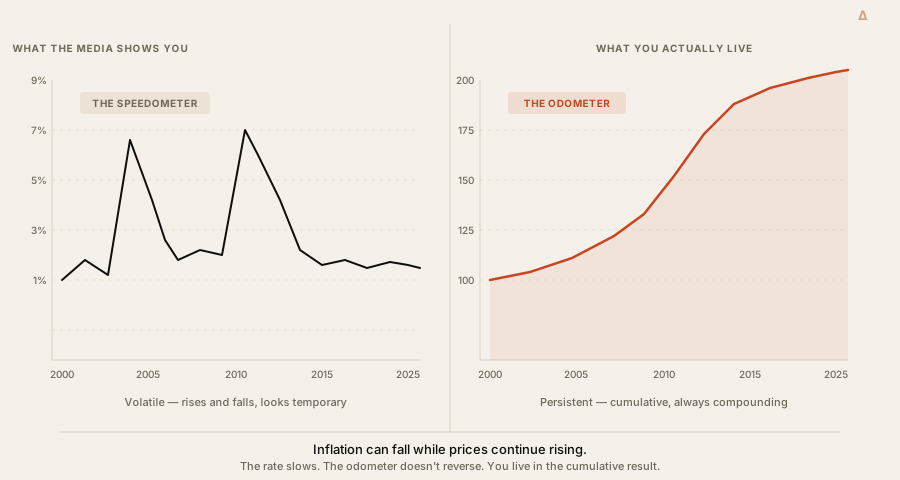
When the media says inflation is falling, they mean the speedometer is slowing. The odometer keeps turning. Prices are still rising — just more slowly.
Inflation can fall while prices continue rising.
This is why the relief never quite arrives. The headline was accurate. The thing you were hoping would happen — prices returning to where they were — is not what falling inflation means.
Why falling inflation does not mean falling prices
Consider a simple example.
If prices rose 9% last year and 3% this year, inflation fell by 6 percentage points. The headlines celebrate.
But prices are 3% higher than last year, which was already 9% higher than the year before.
The odometer didn't reverse. It just slowed down.
Consumers who are waiting for things to return to normal are waiting for something that almost never happens. Deflation — actual falling prices — is rare and typically a sign of economic distress. What most people are actually experiencing is prices at a permanently higher level, now rising more slowly.
The relief they were promised was a slower climb, not a descent.
The compounding problem
Now introduce the second layer, the one almost nobody talks about.
Everyone understands compound returns. Put money to work at 8% annually and watch it grow on itself. The math is elegant and powerful.
Here is the part that gets left out:
The exact same mathematics apply to the things you want to buy.
A $400,000 home appreciating at 6% annually becomes a $716,000 home in 10 years. A $1 million home becomes $1.79 million. College tuition rising at 5% annually doubles its cost in roughly 14 years.
Compound inflation is real. It works exactly like compound returns — except instead of your wealth growing, it is the price of your goals growing.
The same force that builds wealth can also increase the cost of the life you want.
If your wealth compounds slower than your goals, you fall behind. Not because of bad decisions. Not because of insufficient discipline. Simply because the mathematics are working against you, quietly, every year, whether or not you notice.
The Escalator Problem
Picture an escalator moving upward at a steady pace.
You step on and start walking.
If you walk faster than the escalator moves, you gain ground. You get closer to the top.
If you walk at exactly the same speed, you stay in place relative to the destination. You're moving, but not gaining.
If you walk slower than the escalator — even while genuinely moving forward, even while exerting real effort — you fall behind. The top gets further away.
Now replace the escalator with the rising cost of the life you want.
The home you are saving for. The retirement you are planning. The financial independence you are building toward.
These things are not standing still. They are on an escalator. They compound, year after year, whether or not you are watching.
Your savings, your investments, and your income are you walking up the steps.
The question is whether you are walking faster than the escalator is moving.

The finish line is moving
Most financial advice is built on a hidden assumption: that your goals are static.
"Save $200,000 for a down payment."
"Accumulate $1 million for retirement."
These are fixed numbers attached to moving targets.
By the time you reach $200,000 in savings, the home that required a $200,000 down payment may now require $260,000. By the time you accumulate $1 million, the retirement lifestyle that cost $1 million to sustain may cost $1.3 million.
You hit the number. You missed the goal.
This is why so many people feel the floor shifting beneath them even as their bank balance grows. Their targets are not static. They are compounding. And nobody told them to run the math.
CPI is not your life
The Consumer Price Index measures a broad basket of goods and services: food, energy, clothing, housing costs, and services. It is designed to track average consumer experience across the economy.
Your life is not the average.
If you aspire to own a home in a desirable city, your relevant inflation rate is home price appreciation — which has historically outpaced CPI over many long-run periods.
If you are planning to fund a child's education, your relevant inflation rate is tuition.
If you are building toward early retirement with a specific lifestyle, your relevant inflation rate is the cost of that lifestyle — including the assets and expenses that make it up.
CPI answers the question: "What is happening to the average basket of consumer goods?"
The question you actually need answered is: "What is happening to the specific life I am trying to build?"
These are different questions. They often produce very different numbers.
Your desired future has its own inflation rate
Here is what that means practically.
Think about the things you are working toward. A home in a specific place. A retirement that looks a certain way. The option to work less, travel more, support people you love. A business. Financial independence by a certain age.
Each of those goals has its own rate of appreciation. Its own escalator speed.
Housing in high-demand markets has appreciated meaningfully faster than general consumer prices over many long-run windows. Healthcare costs and tuition can move differently from CPI. Broad equity markets can move differently again.
None of those numbers is CPI.
Your personal inflation rate is the weighted average of everything you are trying to afford — weighted by how much of your financial life is oriented toward each goal. Two people earning the same income with the same savings rate can have very different personal inflation rates depending on what they are building toward.
This is why generic financial benchmarks often feel disconnected from lived experience. They are measuring the wrong thing.

Aspire Rate: measuring whether you are gaining ground or falling behind
Once you accept that your goals have their own appreciation rate, one question becomes central:
Is my wealth growing faster than the life I want?
This is what the Aspire Rate is designed to measure.
Aspire Rate is the rate your wealth must grow to keep pace with the cost of the life you want — at your specific goals, your specific timeline, and your specific starting point.
It is not a market benchmark. It is not CPI. It is not a generic savings target.
It is personal. It reflects what you are actually trying to build.
The Aspire Gap is the difference between your projected money growth rate and Aspire Rate. Positive means you are walking faster than the escalator. Negative means the escalator is pulling the finish line away from you faster than you are closing the distance.
The goal is not to be anxious about the gap. The goal is to see it clearly.
You cannot close a gap you cannot measure. You cannot plan for a future you are mismeasuring. And you cannot know whether you are gaining or losing ground on the escalator if you are looking at the wrong chart.
Aspire Rate is an educational planning tool. It does not provide investment, tax, legal, or insurance advice and does not recommend any security or financial product. Outputs reflect the assumptions you enter and are not predictions or guarantees of future outcomes. At these assumptions.
Related reading: