You are not imagining it. For a lot of people, getting ahead feels harder than it used to, even when the paycheck is larger than it has ever been. The raise lands, and somehow the home, the degree, and the comfortable retirement all seem to drift a little further away in the same year that you earned more.
There is a clean way to say what is happening underneath that feeling, and it is more useful than it is comfortable. You are spending more of your life as a consumer of assets that are appreciating, and less of it as an owner of them. The things you are trying to buy keep getting more expensive. And the path that once let ordinary people become owners of the companies driving that growth has quietly narrowed.
This is not a story about villains, and it is not a story about the system being rigged. It is a story about a structural change in how value gets created and who gets to participate in it early. It connects directly to the one question Aspire exists to help you answer: is the future you want becoming more or less affordable?
Here is one way to feel the consumer side of it before we look at the ownership side.
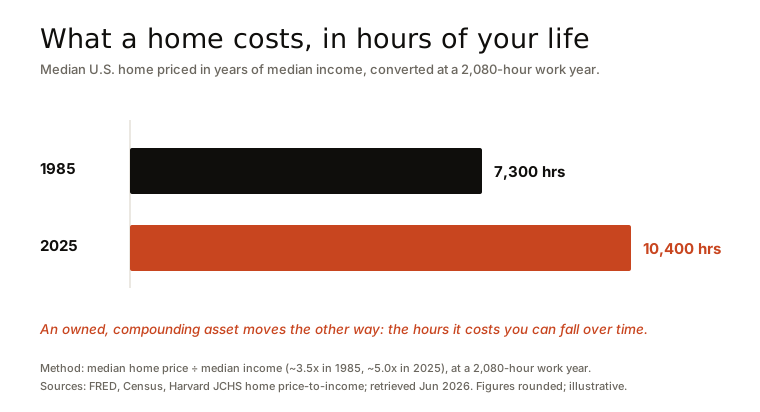
In 1985, a median home in the United States cost about three and a half years of median income. By 2025 it cost about five years of the same income. Convert that into the currency you actually spend, the hours of your one life, at a standard 2,080-hour work year, and a home went from roughly 7,300 hours to roughly 10,400 hours. That is three thousand additional hours of your life, for the same four walls, in a single generation.
A home is something you buy whole and then live in. You cannot buy a fractional house. That is the defining trait of a consumer asset, and it is exactly why its rising hours cost lands in your body. The rest of this piece is about the other side of the ledger, the ownership side, and why the easiest historical route onto it has moved later and further out of reach. We will spend a full section on why this thesis might be wrong, because the honest answer turns out to be more interesting than the alarming one.
The old way: you could own the winners early
For most of the modern era, the public stock market did something quietly remarkable. It let regular people become owners of the economy's best businesses relatively early, and then compound alongside them for decades.
Look at the companies that defined the last forty years and when an ordinary person could first buy in:
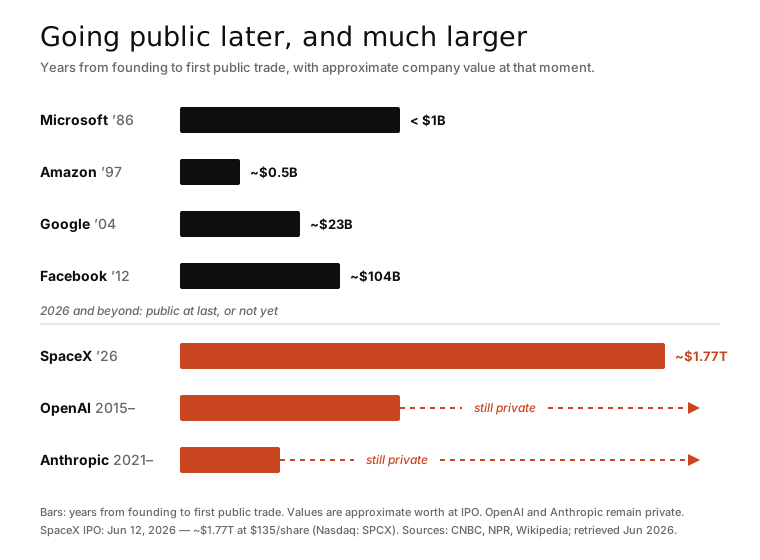
- Microsoft was founded in 1975 and went public in 1986, about eleven years later, worth under a billion dollars.
- Amazon was founded in 1994 and went public in 1997, only about three years later, worth roughly half a billion.
- Google was founded in 1998 and went public in 2004, about six years later, at around 23 billion dollars.
- Facebook, now Meta, was founded in 2004 and went public in 2012, about eight years later, at roughly 104 billion dollars.
Amazon was a toddler when it listed. Almost all of the growth that turned it into a giant happened afterward, in public, where anyone with a brokerage account could own it and ride along. That is the engine a lot of conventional advice still quietly assumes runs at full power: buy broadly, hold for decades, and you will own the next generation of winners early enough for compounding to do the heavy lifting.
Notice, though, how the entry point drifts later and larger across that list. By the time you reach Facebook, the company is already worth more than a hundred billion dollars on its first public day. The window in which the public could become owners kept opening later in each company's life. The question worth investigating is whether that window is still open at all.
The cost of the life you want
Before we follow the ownership thread, it is worth being precise about the consumer side, because it is the part you live every day.
Aspire's central idea is that you should not measure your life against the official inflation rate. You should measure it against the cost of the specific things you are trying to afford. When you do that, the picture looks different from the headline numbers, and it has looked that way for a long time.
Housing is the clearest case, which is why it is the protagonist of this story. The home you want is not keeping pace with your income. It is pulling away from it. Between 1985 and 2023, median household income grew about 241 percent while median home prices grew about 408 percent. The home did not just get more expensive. It got more expensive faster than your ability to pay for it, which is the part that quietly erases a raise.
The same pattern repeats across the rest of an aspirational life, and the hours-of-your-life lens makes it concrete:
- A college degree. Since 1980, college costs have risen roughly 169 percent while pay for young workers rose only about 19 percent, according to a Georgetown analysis. Tuition alone has climbed more than 1,200 percent, against broad consumer inflation closer to 236 percent.
- Family healthcare. The annual cost for a typical family of four rose from about 12,214 dollars in 2005 to about 35,119 dollars in 2025, an increase near 188 percent, while wages over the same stretch grew about 84 percent.
- Childcare. Costs have been climbing about one and a half times faster than overall inflation, and a single child in full-day care now consumes somewhere between 9 and 16 percent of a typical family's income.
None of these are fringe claims. They come from the Federal Reserve, Harvard's Joint Center for Housing Studies, the National Center for Education Statistics, and Milliman. The pattern is consistent: the assets and services that make up a stable, aspirational life have been compounding at rates that wages have not matched.
That gap is the entire reason a personal inflation rate matters more than CPI. If the things you want are growing at 5 to 8 percent a year and your income is growing at 3, the gap does not hold steady. It widens every year you do not earn a high enough return on what you already have. You can run your own number through the calculator to see the rate your specific goals require, or read how Aspire builds these cost-growth assumptions.
The rise of private capital
So if the cost of the consumer side keeps rising, the natural question is the one Aspire is built around. What return do you need to keep up, and can you still get onto the ownership side of the fastest-growing companies, the way an Amazon buyer could in 1997?
Increasingly, the answer is that the ownership happens somewhere you are not invited until late. Over the last three decades, an enormous amount of company growth has migrated out of public markets and into private ones.
The clearest single signal is the number of public companies. The count of US-listed domestic companies peaked at roughly 7,500 to 8,000 in 1996 and sits closer to 4,000 today, a decline of about half. Measured per person, the United States had about 30 public companies per million people in 1996 and only about 14 by 2023. The menu of businesses you can directly own has shrunk even as the economy has grown.
Those companies did not disappear. They stayed private, funded by a pool of private capital that barely existed at this scale a generation ago. US venture capital assets under management grew from under 400 billion dollars in 2015 to over one trillion by 2025. Private market funds as a whole roughly tripled over a decade to something on the order of 26 trillion dollars in gross assets. By one widely cited estimate, about 87 percent of US companies with revenue above 100 million dollars are now private.
The result shows up in how old and large companies are when they finally let the public in. Research from the University of Florida finds the median age at IPO has climbed from roughly 6 to 8 years in the 1980s to around 11 to 14 years recently. The median inflation-adjusted value at IPO rose from about 105 million dollars in 1980 to about 1.33 billion by 2021. And the growth that happens during the private years is not small. One analysis of companies that reached unicorn status and then listed between 2019 and 2025 found a median appreciation of about 65.7 percent per year during the private stretch. That is the steepest part of the climb, and it now happens before you can buy a share.
Put the eras side by side. Microsoft created almost all of its value as a company you could own. SpaceX, which went public in June 2026 at a valuation near 1.77 trillion dollars, had already created the overwhelming majority of its value while private. OpenAI and Anthropic have each been valued in the hundreds of billions with no public shares to buy. You can be a heavy consumer of what these companies make, and still own none of the company making it. That is the ownership gap stated plainly.
The mechanism is not a conspiracy. Companies stay private because they can. Private capital is abundant, public reporting is burdensome, and staying private lets founders and early backers keep control and capture more of the upside. Those are rational choices. But the aggregate effect is that the part of the growth curve most accessible to the public has, on average, shifted later and flatter.
The counterargument
Now the part that matters most, because a thesis you cannot argue against is not worth much. There is a serious case that this access gap is overstated, and it deserves to be made in full.
Access to public markets has never been cheaper or easier. A generation ago, buying stock meant paying real commissions through a broker. Today trading is commission-free at most major platforms, fractional shares let someone put 20 dollars into a 1,000-dollar stock, and a globally diversified portfolio costs a few basis points a year. US stock ownership reached about 62 percent of adults in 2025, the highest since 2008. By this measure the market is more open than ever.
Index funds solved the selection problem. You no longer need to spot the next Amazon early. Own a low-cost index fund and you automatically own every company that graduates to the public market, including the giants that list late. SpaceX's June 2026 listing is the live example: the day it joined the public market, index investors owned it the next day without lifting a finger. When OpenAI or Anthropic eventually lists, it happens again.
Private companies still become public eventually. The growth has not vanished. It has been deferred. A company that lists at a huge valuation still has a future ahead of it, and public investors share in whatever comes next. The claim that all the gains happen in private assumes the public phase is over at listing, which history does not support.
Entirely new asset classes opened. Bitcoin and other crypto assets created a fully public, around-the-clock market that anyone could access from the start, with no accredited-investor gate. Whatever one thinks of the risks, it is hard to argue that access to emerging high-growth assets uniformly narrowed when a whole new category became available to everyone at once.
Regulation is actively widening private access. A 2025 executive order directed regulators to open 401(k) plans to private equity, real estate, and other alternative assets, potentially giving more than 90 million retirement savers a route into markets that were previously reserved for institutions and the wealthy. The door this article describes as closing is, in at least one important way, being pried back open.
Taken together, the counterargument is strong, and the honest synthesis is this: the US market is simultaneously at its most democratized point in history and its most concentrated. Both are true. Anyone can now buy in cheaply, yet the wealthiest 10 percent of households still hold roughly 87 to 93 percent of all stock-market wealth, while the bottom half holds about 1 percent. What has broadened is the ability to own. What has narrowed is access to the earliest, steepest part of the growth curve. An index fund will eventually own the late-arriving giant. It will simply own it after the 65-percent-a-year private stretch is already over.
The access gap
Step back, and the two halves of this piece turn out to be the same problem.
A home, an education, good health, and a stake in growth are not four separate line items. They are four kinds of access. Access to stability. Access to opportunity. Access to health. Access to compounding. The first three are the consumer side of your life, and they have all been getting more expensive in hours. The fourth is the ownership side, and it is the one that determines whether the other three stay within reach.
Here is the part that makes this Aspire's idea and not a complaint. Access to compounding is becoming the master key. When your money grows faster than the things you need, the doors open one by one. When it does not, they close the same way. The reason a home now costs more hours of your life is not only that homes got expensive. It is that the money most people hold did not compound fast enough to keep pace. An owned, compounding asset is the only thing on this entire list whose hours-to-afford can actually fall for you over time, because it pays you back while you sleep.
That is the real significance of the structural shift. It is not that ownership disappeared. It is that ownership matters more than ever, precisely because so much of it now happens out of public view, and because the costs you are racing against keep compounding whether you participate or not.
What you can do about it
This section is educational, not financial advice. Aspire does not tell you what to buy. It helps you understand the math of your own situation so you can make better decisions, or ask a qualified advisor sharper questions.
A few principles follow naturally from the evidence above.
Measure the right inflation rate. Stop benchmarking your progress against CPI and start benchmarking it against the appreciation rate of your actual goals. A home in your target area, the specific schools you care about, and a realistic retirement basket each have their own growth rate. Those are the numbers that decide whether the future is getting closer or further away.
Know Aspire Rate before you judge any opportunity. A return target only means something relative to what you need. An investment promising 8 percent is exciting if your required rate is 5 and inadequate if it is 10. The number comes first. Every opportunity, public or private, gets judged against it. You can calculate yours here and then model how different returns change your gap on a home or a degree.
Treat broad, low-cost ownership as the default, not the fallback. The counterargument is right that index investing captures the winners eventually, and for most people that reliability is the feature. The fact that the earliest growth now happens in private does not make public ownership worse. It makes a clear-eyed view of your required return more important, because the consumer side of your life is not waiting.
Be skeptical of newly opened private access. As 401(k) plans and retail platforms open to private assets, the distance between marketing and reality will be wide. Higher potential returns arrive bundled with higher fees, long lock-ups, and weaker disclosure. None of that is disqualifying, but all of it should be weighed against your number rather than against the thrill of access for its own sake.
The thread running through all of these is the same. The future is not equally affordable, and it is not affordable by accident. It becomes affordable when the growth rate of your resources keeps pace with the growth rate of your goals. That is a number you can actually calculate.
Conclusion
The companies that built the modern economy used to grow up in public, where anyone could become an owner early and compound alongside them. Increasingly they grow up in private, where a smaller group captures the steepest part of the climb before the rest of us are invited in. At the same time, the homes, degrees, and healthy years people are working toward have been costing more and more hours of their lives.
None of that means the future is hopeless. Access to public markets is cheaper and broader than ever, index funds still capture the eventual winners, and the door to private markets is even being widened. The system is genuinely both more open and more concentrated than it has ever been. What is not in doubt is the implication for you. The rate of return you need to afford the life you want has gone up, because your goals are compounding and the easy shortcuts onto the ownership side have narrowed.
A home, an education, health, and a stake in growth are all forms of access, and the key that unlocks them is the same. So the most useful thing you can do is stop guessing at the rate you need and start measuring it.
You can't out-earn a compounding future. You can only out-own it.
Is the future you want becoming more or less affordable? You do not have to wonder. You can calculate it.
Frequently asked questions
Are companies really staying private longer? Yes. The median age of a US company at its IPO has roughly doubled, from about 6 to 8 years in the 1980s to about 11 to 14 years recently, and the inflation-adjusted median value at IPO has risen more than tenfold. Companies now list older and far larger than they used to.
Does this mean ordinary investors are locked out of growth? Not entirely. Access to public markets is cheaper and broader than ever, and index funds automatically capture companies once they list, including the late-arriving giants. What has narrowed is access to the earliest, fastest phase of growth, which increasingly happens before any public listing.
Why are there fewer public companies than there used to be? The number of US-listed public companies peaked around 7,500 to 8,000 in 1996 and is now closer to 4,000. The decline reflects fewer IPOs, more mergers and buyouts, and an abundance of private capital that lets companies grow without going public.
What does any of this have to do with inflation? Aspire focuses on the inflation rate of the things you actually want to buy, like a home, a degree, or a secure retirement, rather than the official CPI. Those aspirational costs have generally grown faster than wages for decades, which raises the rate of return you need on your money to keep up.
What is an Aspire Rate? Aspire Rate is the rate of return you need to achieve in order to afford the future you want, measured against the real appreciation of your specific goals. Knowing it lets you judge any opportunity against a concrete standard instead of a vague hope.
Should I invest in private companies now that 401(k)s are opening up to them? This article is educational and not investment advice. As private access widens, the gap between marketing and reality can be large, with higher fees, lock-ups, and weaker disclosure. A useful first step is to know your required return, then evaluate any opportunity, public or private, against it. For personalized advice, consult a qualified financial professional.
Aspire is an educational planning tool. The content above is for general information and is not investment, tax, or legal advice. Private-company valuations referenced here are approximate, drawn from secondary-market and funding-round estimates as of mid-2026, and change frequently. See our methodology for how cost-growth figures are calculated.