Direct answer
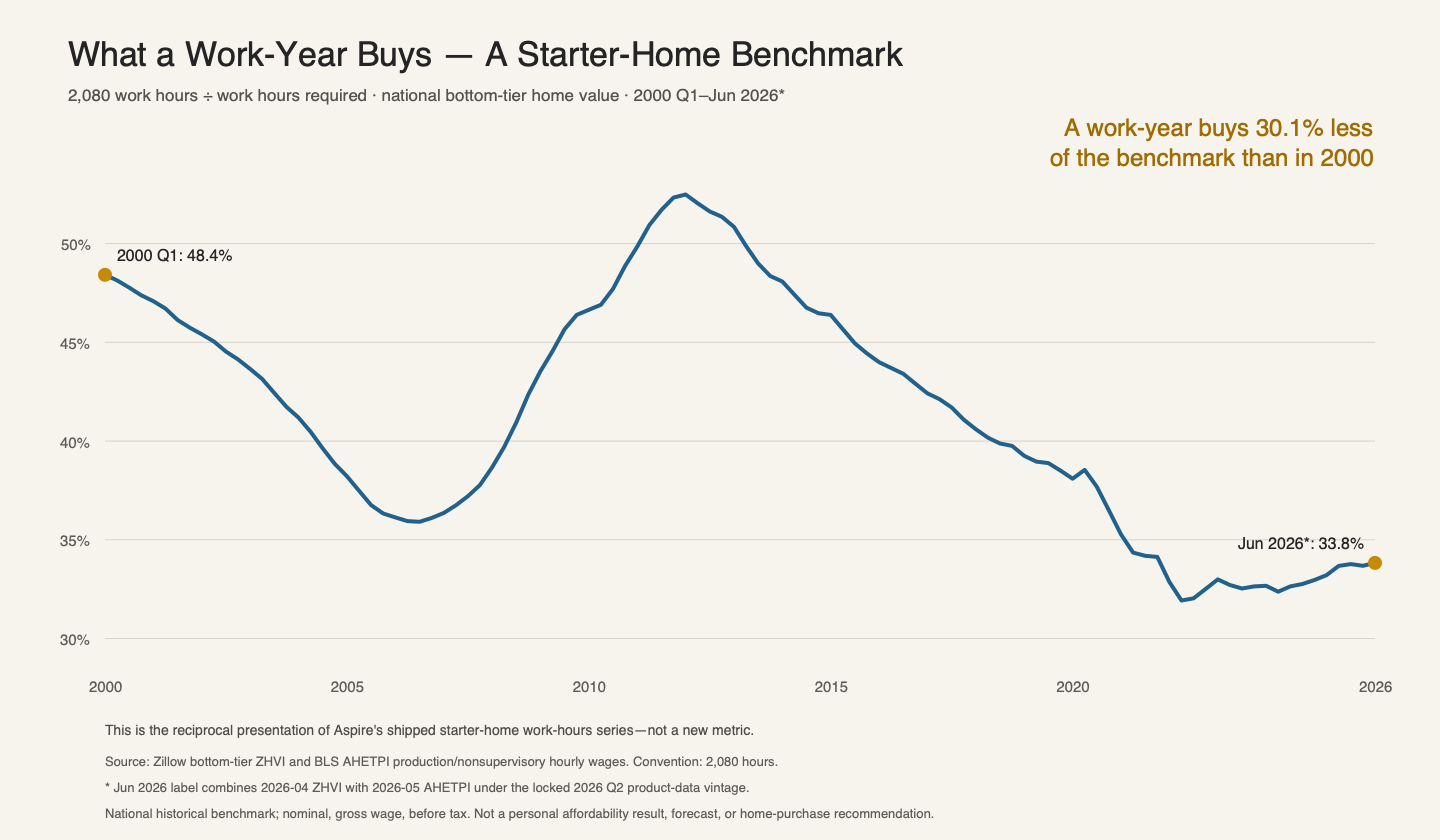
At these aggregate benchmark assumptions, one 2,080-hour work-year bought 48.4% of a defined national bottom-tier home-value benchmark in 2000 Q1.
By June 2026*, it bought 33.8%.
That is 30.1% less purchasing reach against the same defined benchmark.
* The June 2026 label uses the locked Aspire product-data vintage: April 2026 Zillow ZHVI and May 2026 BLS AHETPI wages.
Educational and assumption-based only. This historical national benchmark uses nominal Zillow bottom-tier ZHVI and gross BLS AHETPI wages. It is not a personal affordability result, forecast, or home-purchase recommendation. Personal results depend on the assumptions entered.
A bigger paycheck can still lose ground
Income can rise while a specific life goal moves faster.
That is the disconnect most financial tools miss. A paycheck tells you what changed in the numerator. It does not tell you whether the home, family plan, education, healthcare, retirement, or freedom you want moved further away.
For this historical benchmark, the national bottom-tier home value rose faster than the production and nonsupervisory hourly wage series used in Aspire's shipped starter-home dataset. The result is not that work became worthless. It is that one defined work-year reached less of one defined goal benchmark.
The calculation is deliberately simple
Aspire's shipped starter-home series starts with two source-stamped inputs:
- Goal benchmark: Zillow's national bottom-tier ZHVI: the 5th-35th percentile of home values, single-family plus condo, smoothed and seasonally adjusted.
- Wage benchmark: BLS/FRED AHETPI: average hourly earnings for U.S. private production and nonsupervisory jobs.
The product series calculates:
hours_required = round(
  national_bottom_tier_ZHVI / AHETPI_hourly_wage
)
What Your Work Buys shows the same information in the opposite direction:
share_bought_by_one_work_year = 2,080 / hours_required
relative_change = (latest_share / baseline_share) - 1
This is a reciprocal presentation of Aspire's existing work-hours dataset. It is not a new product metric, formula, score, badge, or index.
Scroll horizontally to see all columns.
| Historical national benchmark | 2000 Q1 | Jun 2026* |
|---|---|---|
| National bottom-tier ZHVI | $59,504.61 | $198,648.86 |
| AHETPI hourly wage benchmark | $13.85 | $32.31 |
| Work hours required | 4,296 | 6,148 |
| Work-years required | 2.07 | 2.96 |
| Share bought by one 2,080-hour work-year | 48.4% | 33.8% |
Why this is not a household-income story
AHETPI measures production and nonsupervisory jobs. It is not a median person, household income, take-home pay, or Aspire's high-income, asset-light audience.
Aspire uses it here for one narrow reason: it is the wage denominator in the already-shipped 106-row starter-home work-hours series. Replacing it in this article would create a second starter-home history with different endpoints and refresh behavior.
For a new cross-goal benchmark built from scratch, another numerator may be cleaner. For this derivative, preserving the shipped AHETPI series is the more honest choice, as long as the label stays precise.
What the benchmark does, and does not, say
It does show:
- how much of one defined national home-value benchmark a fixed 2,080-hour work-year equaled at each historical observation;
- whether the wage benchmark gained or lost purchasing reach against that goal benchmark; and
- how the same shipped dataset looks when expressed as goal share rather than hours required.
It does not show:
- whether a particular person can afford a home;
- after-tax cash available for a purchase;
- a down payment, mortgage payment, qualification threshold, taxes, insurance, maintenance, HOA costs, or repairs;
- a local starter-home price;
- whether anyone should buy, wait, rent, relocate, borrow, refinance, or invest; or
- a forecast of future home prices or wages.
The Zillow bottom tier is a national value index. Starter home is Aspire's editorial shorthand for this defined benchmark, not a claim that every local entry-level home has the same price.
The useful question is personal
The historical benchmark is the realization. Your own assumptions are the decision layer.
The Personal-Hours Lens keeps income in the browser and translates an entered goal into work time at the assumptions selected. It does not attach income or exact goal dollars to analytics or share links.
The Home calculator adds a timeline, future-cost path, current resources, and planned contributions. That is where Aspire shows whether the modeled money path is catching up or falling behind, and the rate required at those assumptions.
Sources and methodology
- Aspire starter-home hours dataset: 106 derived observations from 2000 Q1 through June 2026.
- Zillow Research data: ZHVI bottom tier, 5th-35th percentile, single-family plus condo, smoothed and seasonally adjusted, United States.
- BLS/FRED AHETPI: Average Hourly Earnings of Production and Nonsupervisory Employees, Total Private.
- Aspire methodology: source and formula documentation.
- The Escalator Problem: why a goal can move away while income rises.