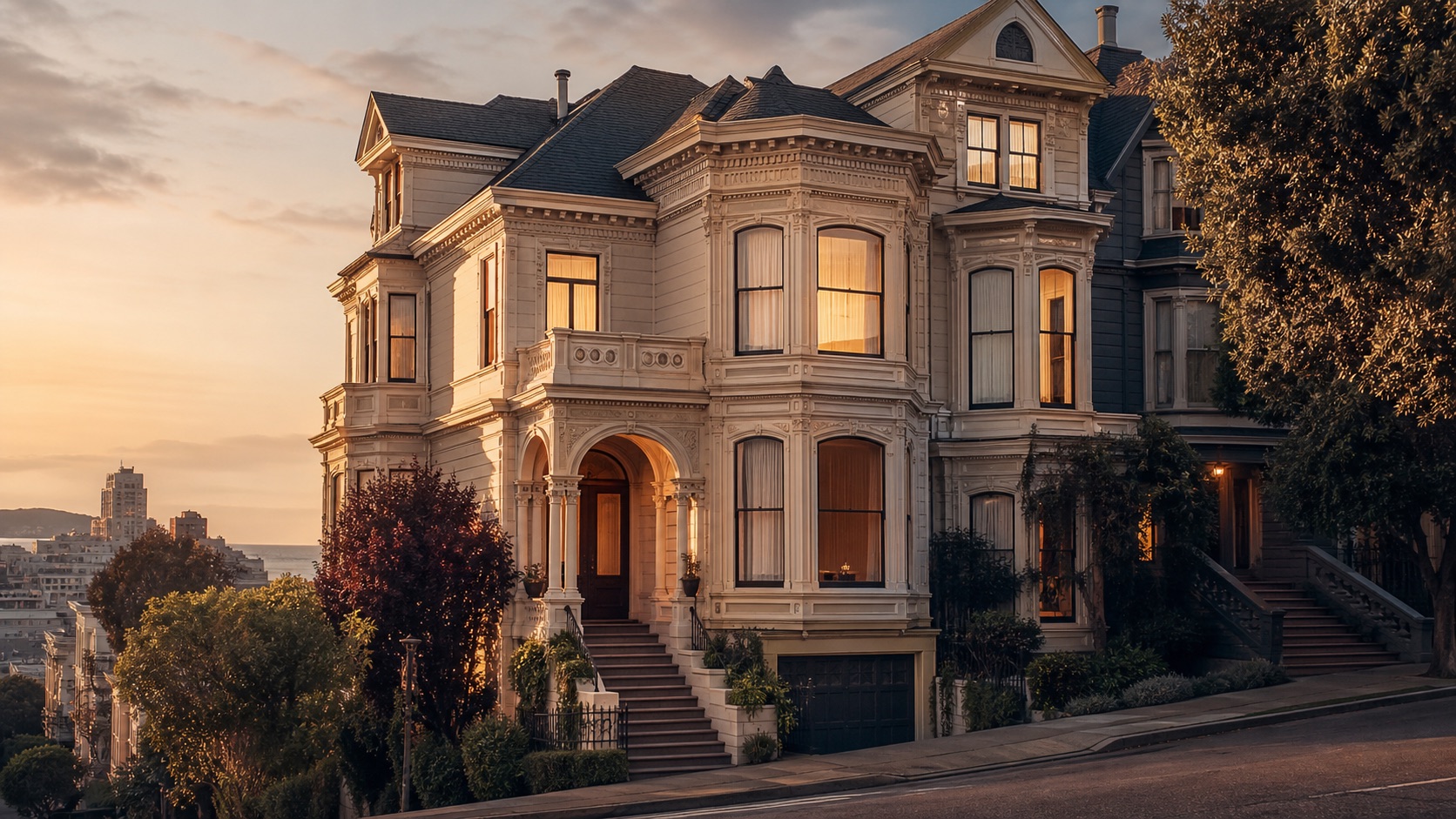
Where is the Full House house, and what would it cost today?
The Tanner house exterior is 1709 Broderick Street in San Francisco's Lower Pacific Heights. The real facade sold for $6 million in April 2025; at these assumptions, the older $441,000 comparison is treated as an editorial scenario input, not a documented sale record.
Then-vs-now: the home figure rises roughly 13.6x, while the wage benchmark used for the hours translation rises about 5.6x. The sitcom kept the Victorian in memory. The market moved the denominator.
Salary-to-afford metro pages are not live yet, so this bridge routes to the closest shipped home-affordability and future-cost surfaces.
| Property | 4-BR Victorian |
|---|---|
| Then | $441,000 purchase price · editorial scenario input; ~$60,000 salary · editorial scenario input |
| Now | $6,000,000 sale of 1709 Broderick Street · documented record published April 2025; $180,000 salary comparison · editorial scenario input |
| Priced in hours | ~48,900 hours then · ~119,900 hours now, at these assumptions |
Danny Tanner was a single father hosting a local morning show, owning a landmark Broderick St Victorian. The real exterior sold for $6M in 2025.
Full House sold America a very San Francisco fantasy: a large Victorian, a crowded family, and enough rooms for sitcom logistics to breathe. Danny Tanner is not presented as a mogul. He is a local morning TV host and a widowed father. The house is beautiful, but in the late 1980s the premise still worked as family television. A professional salary, some narrative convenience, and a very photogenic exterior could sit in the same frame.
The numbers now make the frame harder to hold. The Broderick Street Victorian is tied here to a $441,000 editorial scenario purchase price and a roughly $60,000 editorial scenario morning-anchor salary. That ratio was already stretched. San Francisco was never a bargain-basement city. But the gap between local professional earnings and the house had not yet become the whole story.
The real facade sold for $6 million in 2025, while the comparable salary figure carried in this scenario rises to about $180,000. The salary tripled. The home price moved more like fourteen times. That is the part that matters. The asset did not wait for the job market to catch up.
A city can become richer while becoming less attainable to the occupations that once defined its middle-class texture. Put in purchasing-power terms, the benchmark is not general inflation when the desired future includes a specific neighborhood and property type. The benchmark is that local asset path.
The visual memory is almost too strong: the painted facade, the bay windows, the impossible domestic square footage. But visual memory is a bad price index. It freezes the house in emotional dollars while the market keeps compounding in real ones, year after year.
Aspire's concept is built for exactly this mismatch. The question is not whether Danny Tanner could close on the house with perfect underwriting. The question is what happens when the cost of a life basket compounds faster than the income or resources meant to support it. At these assumptions, that Victorian is a visible Aspire Gap. The house kept its silhouette. The purchasing power required to stand behind that silhouette changed dramatically.
Sources and assumptions
- Location and current sale record: SFGATE reported that 1709 Broderick Street sold for $6,000,000 on April 7, 2025 after a $6.5 million listing and later price reduction; retrieved July 4, 2026. Labeled here as a documented record.
- Then purchase price: $441,000 is retained from the prior page as an editorial scenario input for the 1987 setting; no public record was verified in this pass.
- Salary comparison: $60,000 then and $180,000 now are retained from the prior page as editorial scenario inputs, not occupational wage claims.
- Wage benchmarks: FRED/BLS AHETPI, $9.02 national private production-and-nonsupervisory hourly wage in January 1987; FRED/BLS San Francisco metro total private average hourly earnings, $50.06 in May 2026; retrieved July 4, 2026.
The hours row uses wage benchmarks as an affordability denominator. It is not a claim about Danny Tanner's exact income, mortgage, taxes, or household budget.
Quick questions
Where is the Full House house?
The exterior used for the Tanner family home is 1709 Broderick Street in San Francisco's Lower Pacific Heights. Interior scenes were filmed on a studio set.
What would the Full House house cost today?
The real 1709 Broderick Street facade sold for $6 million in April 2025. That is a documented sale record, not a modeled listing price, and it is used here at these assumptions.
Is this a real listing?
No. The page uses a documented past sale and labeled scenario inputs for an educational comparison; it is not a claim that the house is currently listed for sale.
Compare another pop-culture home
Barney Miller · Good Will Hunting · Home Alone · Married with Children · Seinfeld · The Simpsons