Where is the Simpsons house, and what would it cost today?
742 Evergreen Terrace sits in Springfield, a location the show deliberately leaves unspecified. Aspire does not price it in dollars. At these assumptions, the closest honest proxy is the starter-home-hours series: 2.07 work-years in 2000 Q1 versus 2.96 work-years in June 2026.
There is no Springfield metro proxy on purpose; this page routes to the dataset and home-affordability calculator instead.
| Property | Detached single-family |
|---|---|
| Then | 2.07 work-years · 2000 Q1 CSV reading |
| Now | 2.96 work-years · June 2026 CSV reading |
| Priced in work-years | 2.07 work-years then · 2.96 work-years now, at these assumptions |
Springfield is nowhere on the map so that it can be everywhere in the audience.
742 Evergreen Terrace works as a joke precisely because no one can find it. The show has spent decades letting fans argue over which state Springfield sits in, and the ambiguity is the point: a town with no coordinates can stand in for every town. The house itself is just as generic on purpose — a detached single-family box, a yard, a two-car driveway, a dog. It is the national default rendered in animation, which makes it an unusually honest specimen to price.
Homer's job does the same flattening work. A safety inspector at the local power plant is written as the least remarkable occupation the writers could invent — steady, unglamorous, non-credentialed, the kind of job the show never asks the audience to admire or envy. One paycheck from that job carries a mortgage, three kids, two cars, and a dog. When the show premiered in 1989, that bundle read as unremarkable, almost boring by design. It was the setup, not the punchline.
Aspire's starter-home-hours series prices that exact bundle at the national level, which is the right unit for a town that refuses to be located. The earliest reading in the published series, 2000 Q1, puts the national bottom-tier starter home at 2.07 work-years of the median production wage. The June 2026 reading puts the same tier at 2.96 work-years, at these assumptions. Same house tier, same one-earner premise, roughly 43 percent more of a working life standing between a paycheck and the front door.
Nothing about the show caused that drift, and nothing about the show corrected for it either. The Simpsons is famous for refusing to age its characters while the world around them keeps moving — Bart stays ten, Homer stays at the plant, the house stays lived-in and comfortable. That trick is what makes the math interesting: the fictional household is frozen at 2000-era assumptions while the real denominator underneath it, the work-years required to buy the tier of house Homer already owns, kept climbing through 2024's 3.06 peak and back down to 2.96 by June 2026.
The joke has quietly inverted itself. What once read as "default American family" now reads as "family whose economics require an unstated subsidy the show never has to explain, because cartoons don't pay mortgages." Homer's deal — one ordinary paycheck buys the whole bundle — has become the most quietly dated premise in a show built entirely on never dating its premise.
The show gives no dollar figure for Homer's salary or the house itself, and Aspire supplies none either — the comparison runs a fixed fictional household against a moving national series, which is a fairer test than pricing a cartoon against a single city's rent roll. The dataset behind it is quarterly, source-stamped, and free to inspect at /data/starter-home-hours/. The reader's own version of Homer's question — what does my bundle cost in hours of my own work — lives at /feel-behind/.
Sources and assumptions
- Work-years series: Aspire starter-home-hours dataset, using
data/starter-home-hours/starter-home-hours.csv; 2000 Q1 reading is 2.07 work-years and June 2026 reading is 2.96 work-years. - Numerator source: Zillow bottom-tier ZHVI, 2026-04 vintage, as represented in the Aspire starter-home-hours CSV.
- Denominator source: BLS/FRED AHETPI, 2026-05 vintage, as represented in the Aspire starter-home-hours CSV.
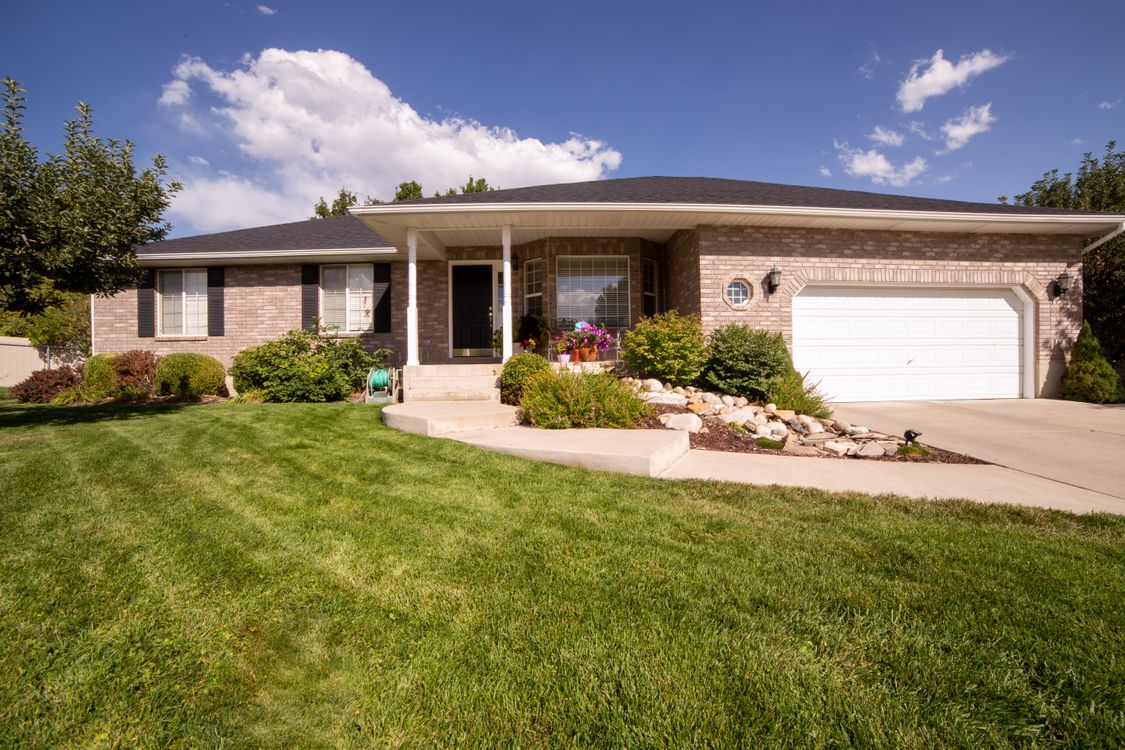
- Image: Pexels photo by Get Lost Mike, used under the Pexels License as an illustrative single-family home exterior only.
This page uses a national starter-home work-years proxy because Springfield has no specified real-world location. It is not a claim about a listing, metro, household budget, or Homer's income.
Quick questions
Where is the Simpsons house?
The Simpsons house is 742 Evergreen Terrace in Springfield, but Springfield's location is deliberately never specified. That ambiguity is the point.
What would the Simpsons house cost today?
Aspire does not price it in dollars. Per the starter-home-hours series, it prices at 2.96 work-years in June 2026 versus 2.07 work-years in 2000 Q1, at these assumptions.
Is this a real listing?
No. This is a national starter-home work-years series applied to a fictional bundle, not a specific property or listing.
Compare another pop-culture home
Barney Miller · Full House · Good Will Hunting · Home Alone · Married with Children · Seinfeld