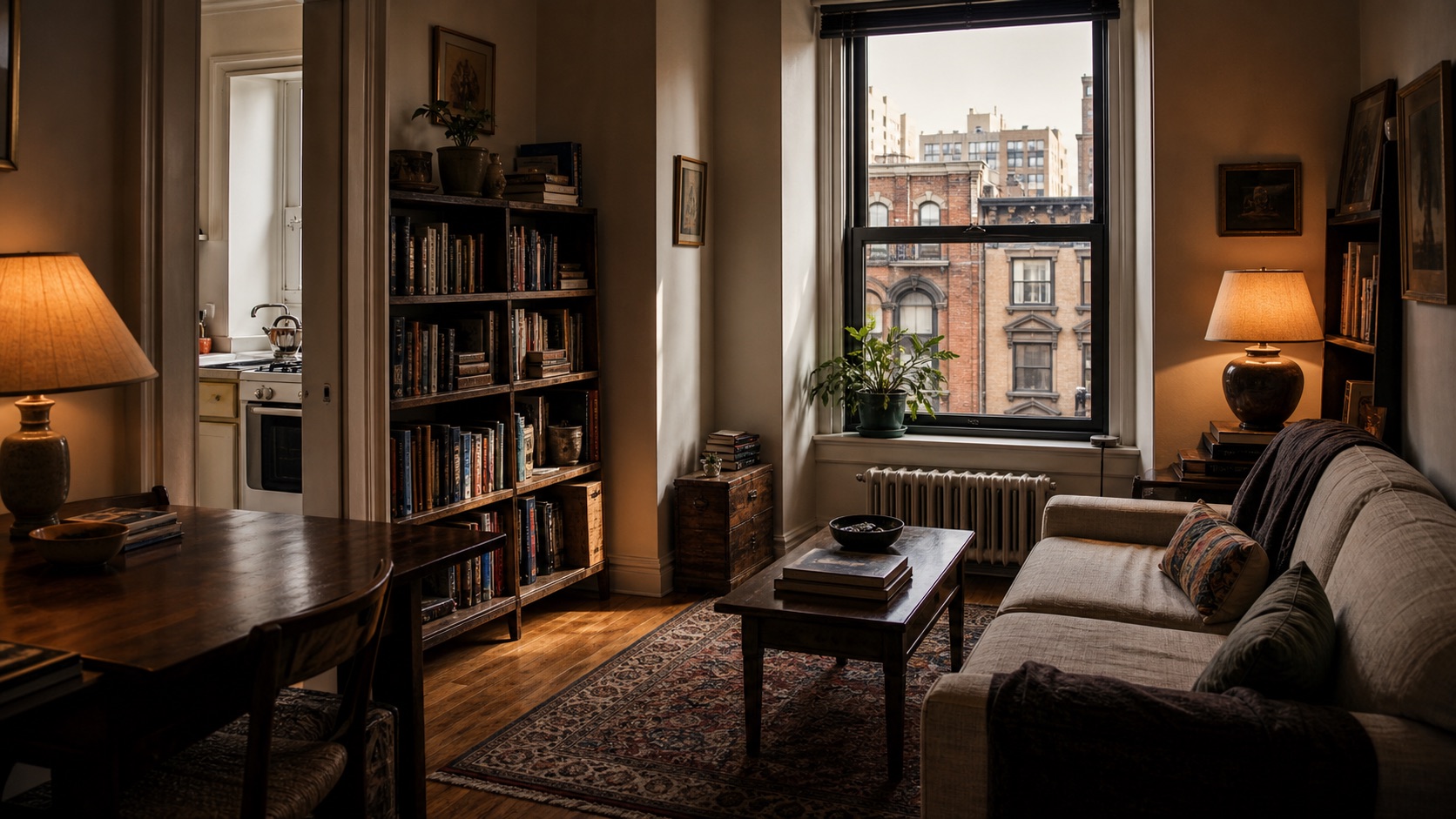
Where is Jerry Seinfeld's apartment, and what would it cost today?
Jerry's apartment is placed at 129 West 81st Street on Manhattan's Upper West Side. StreetEasy notes that apartment 5A is fictional; at these assumptions, a current Upper West Side one-bedroom rent proxy is about $5,100 a month, versus about $1,200 a month in the show's early 1990s setting.
Then-vs-now: the rent is roughly 4.3x higher, while the wage benchmark used for the hours translation rose about 4.0x. The apartment still looks like a normal sitcom box. The denominator changed.
Salary-to-afford metro pages are not live yet, so this bridge routes to the closest shipped home-affordability and future-cost surfaces.
| Property | Spacious 1-BR |
|---|---|
| Then | ~$1,200/mo rent · early-1990s editorial scenario input |
| Now | ~$5,100/mo Upper West Side 1BR rent proxy · retrieved June 10, 2026 |
| Priced in hours | ~116 hours/month then · ~124 hours/month now, at these assumptions |
The show's premise of friends doing absolutely nothing was only possible because NYC was cheap enough to fail in.
Seinfeld's apartment is one of television's great economic illusions because the show refuses to make money the main subject. Jerry is a working comedian, not a banker. His friends drift in and out. The plot runs on wasted afternoons, small grievances, and the ability to treat Manhattan as a neighborhood rather than a gated economic platform.
The rent is the hidden subsidy. Around 1991, a spacious Upper West Side one-bedroom is framed here near $1,200 a month. A club spot for a comedian might pay around $75. That is not wealth. It is a city cheap enough to allow professional uncertainty, odd schedules, and underemployment to remain socially interesting instead of immediately catastrophic.
Today the comparable rent proxy is closer to $5,100 a month. Rent moved like an asset. The small earned unit of creative work barely moved at all. That mismatch changes the story. A comedian can still live in New York, but the margin for doing nothing has been priced down to the bone.
This is the difference between income inflation and lifestyle inflation. If the thing you need most is local housing in a scarce neighborhood, the relevant benchmark is not the average price level. It is the rent path for that neighborhood and that unit type, compared with the income path available to your actual work.
The apartment is doing more work than the laugh track admits. It gives the characters proximity, spontaneity, and the luxury of wasting time near each other. When rent consumes that margin, the city can still produce ambition, but it becomes less available for drift, failure, and low-stakes reinvention.
Aspire turns that comparison into a planning lens. Your future has its own inflation rate because your future contains specific items, not averages. At these assumptions, Jerry's apartment says the quiet part out loud: some cities did not just get more expensive. They became less tolerant of economically messy lives. That is a different city rhythm, with less room for the casual economic slack the show relied on. The premise needed exactly that slack.
Sources and assumptions
- Location: StreetEasy page for 129 West 81st Street, retrieved June 10, 2026; StreetEasy notes apartment 5A is fictional.
- Current rent proxy: Apartments.com New York rent trends, Upper West Side one-bedroom average rent of about $5,104, data updated June 2026; rounded to $5,100, retrieved June 10, 2026.
- Then rent proxy: editorial scenario input already used on this page, about $1,200 per month for the early-1990s Seinfeld setting.
- Wage benchmarks: FRED/BLS average hourly earnings, $10.37 national private hourly wage in January 1991 and $41.11 NYC metro private hourly wage in April 2026, retrieved June 10, 2026.
The hours row uses available BLS wage series as an affordability denominator. It is not a claim about Jerry's exact income, lease, taxes, or household budget.
Quick questions
Where is Jerry Seinfeld's apartment?
The show places it at 129 West 81st Street on the Upper West Side. Apartment 5A is fictional.
How much would the Seinfeld apartment rent for today?
At these assumptions, the current one-bedroom rent proxy is about $5,100 a month using June 2026 Upper West Side market data.
Is this a real listing?
No. It is a market-level rent proxy tied to the fictional address and neighborhood, not a claim about a specific available unit.
Compare another pop-culture home
Barney Miller · Full House · Good Will Hunting · Home Alone · Married with Children · The Simpsons