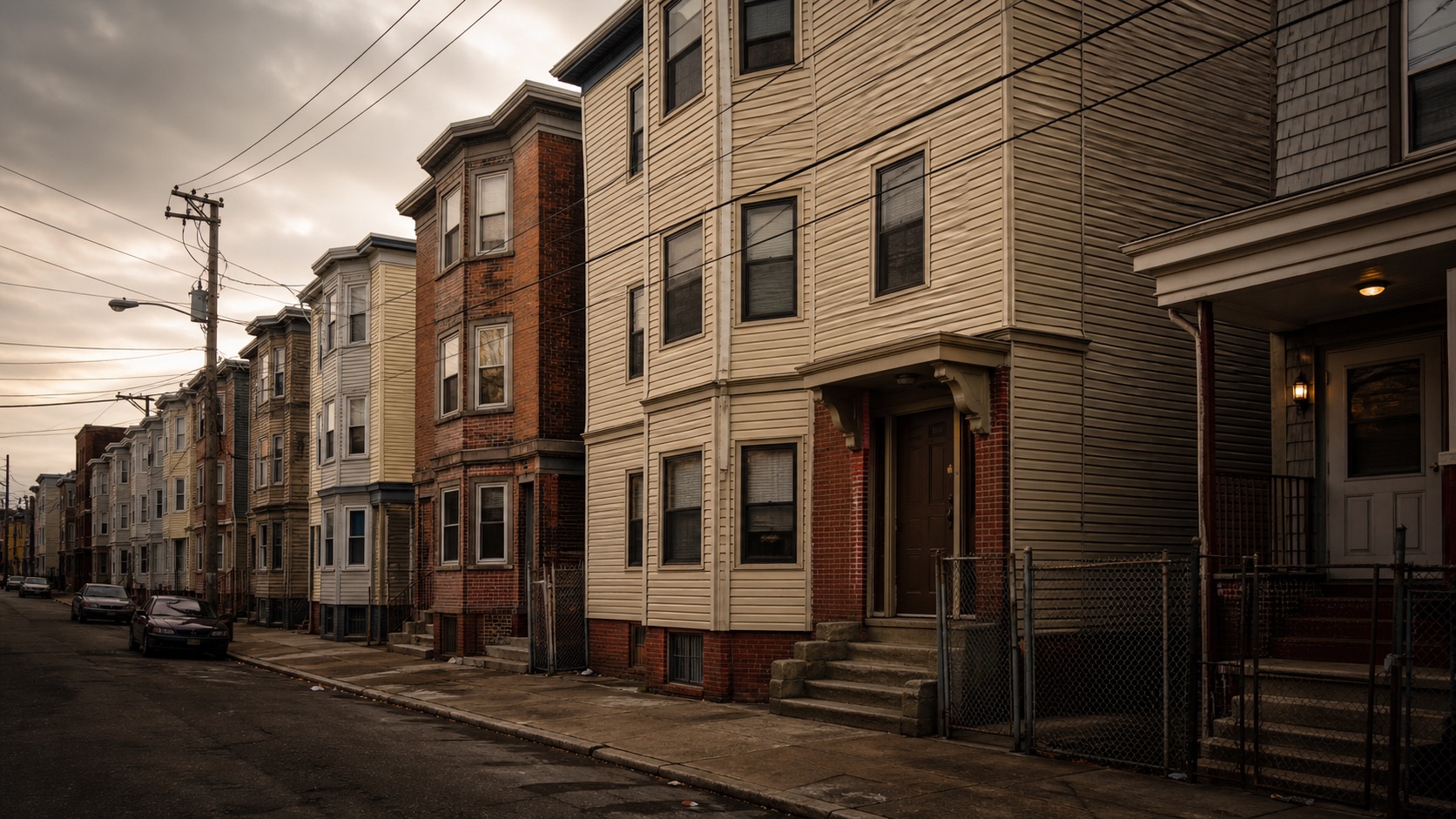
Where is Will Hunting's flat, and what would it cost today?
Will Hunting's flat is placed in South Boston, not tied to a verified real address. At these assumptions, the current neighborhood home-value proxy is about $895,000, and the Boston city rent proxy is about $3,450 a month, versus an $800 monthly rent scenario for the 1997 setting.
Then-vs-now: the rent proxy rises about 4.3x, while the wage benchmark used for the hours translation rises about 3.7x. The Southie premise still scans emotionally. The price path changed who can stay.
Salary-to-afford metro pages are not live yet, so this bridge routes to the closest shipped home-affordability and future-cost surfaces.
| Property | Triple-Decker Flat |
|---|---|
| Then | ~$140,000 Southie home-value comparison · editorial scenario input; ~$800/mo rent · editorial scenario input |
| Now | ~$895,000 South Boston neighborhood ZHVI · dated market proxy through May 2026; ~$3,450/mo Boston city rent index · dated market proxy through May 2026 |
| Priced in hours | ~65 hours/month then · ~75 hours/month now, at these assumptions |
Will Hunting mopped floors and rented a simple flat in South Boston. Today, South Boston is modeled here with an ~$895k neighborhood home-value proxy.
Good Will Hunting depends on a particular Boston geography. Will is not merely smart and angry. He is rooted in South Boston before the neighborhood's later re-pricing became the point. He works as a custodian, drinks with friends, gets into trouble, and rents a plain flat close enough to feel local rather than aspirational. The setting makes his life legible: working-class, compressed, proud, and close to the institutions he refuses to join.
The housing math changed the meaning of that setting. In the late 1990s, a Southie home-value comparison around $140,000 and rent near $800 a month are carried here as editorial scenario inputs. Those numbers did not make life easy. They made the premise possible. A laborer could rent nearby without the whole plot becoming a real estate fantasy.
Today the South Boston neighborhood home-value proxy is about $895,000, and the Boston city rent index is about $3,450 a month. Those are dated market proxies, not a specific listing. The increase rewrites who can live there, how much error they can absorb, and whether a young worker can remain close to the community the story is built around.
The movie keeps returning to loyalty: friends, blocks, bars, jobs, and the right to stay close to the place that formed you. When rent reprices that sharply, loyalty becomes expensive. The same neighborhood identity can survive on screen while becoming harder to finance in real life.
This is why housing inflation is more personal than a national price index. South Boston did not simply get more expensive at the same pace as everything else. Its local desirability, redevelopment, income mix, and housing scarcity compounded into a different path. A national CPI number cannot tell you whether your neighborhood moved onto a much steeper local price path.
Aspire treats that difference as the product problem. Your gap is the distance between the cost growth of the life you are pricing and the growth of the money assigned to it. At these assumptions, Will's flat works as a local inflation chart with better dialogue. That is how a place can remain emotionally working class while its entry price becomes something else entirely.
Sources and assumptions
- Current home-value proxy: Zillow Research neighborhood ZHVI, South Boston, Boston, MA, $894,936.21 as of 2026-05-31; direct CSV retrieved July 4, 2026. Labeled here as a dated market proxy and rounded to $895,000.
- Current rent proxy: Zillow Observed Rent Index city series, Boston, MA, $3,454.01 as of 2026-05-31; direct CSV retrieved July 4, 2026. Labeled here as a dated market proxy and rounded to $3,450.
- Then home-value and rent figures: $140,000 and $800/month are retained from the prior page as editorial scenario inputs for the 1997 setting; no public record was verified in this pass.
- Wage benchmarks: FRED/BLS AHETPI, $12.29 national private production-and-nonsupervisory hourly wage in January 1997; FRED/BLS Boston metro total private average hourly earnings, $45.89 in May 2026; retrieved July 4, 2026.
The hours row uses rent proxies because the character is framed as renting. It is not a claim about Will's exact lease, income, taxes, or household budget.
Quick questions
Where is Will Hunting's flat?
The movie places Will in South Boston. This page models that as a South Boston neighborhood housing proxy, not a specific address.
What would Will Hunting's South Boston flat cost today?
Using Zillow's May 2026 South Boston neighborhood ZHVI, the home-value proxy is about $895,000. For the rental version of the story, Zillow's Boston city rent index is about $3,450 per month, at these assumptions.
Is this a real listing?
No. It is a market-level proxy for South Boston and Boston rents, not a claim about a specific available unit.
Compare another pop-culture home
Barney Miller · Full House · Home Alone · Married with Children · Seinfeld · The Simpsons